Higher education in the Lone Star State is propelled by immense flagship research institutions, rapid aerospace and semiconductor industry expansion, and the landmark Texas Uniform Admissions Policy (Top 10% Rule). From the competitive urban research campus of The University of Texas at Austin (UT Austin) to the 75,000-strong Aggie engineering corps at Texas A&M University, Texas provides world-class undergraduate training backed by robust state endowment funds and generous in-state tuition subsidies.
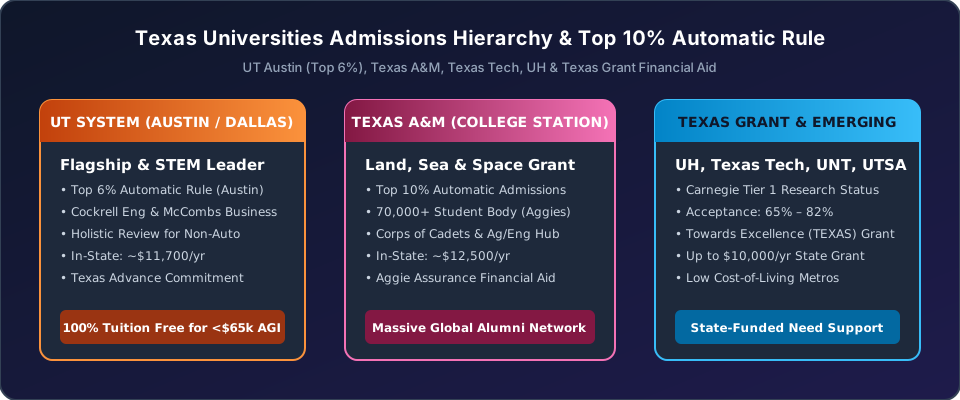
1. The Texas Uniform Admissions Policy: Top 10% Rule & UT Austin Top 6%
Enacted under Texas Education Code § 51.803, the Texas Uniform Admissions Policy guarantees automatic admission to all Texas public four-year universities for Texas high school seniors who graduate in the top 10% of their class. However, because demand for UT Austin vastly exceeds available classroom capacity, the Texas Legislature authorized the university to limit automatic admissions to 75% of its in-state freshman cohort:
- UT Austin Automatic Cutoff: Currently pegged at the Top 6% of graduating seniors. While automatic admission guarantees entry into the university's College of Liberal Arts, it does not guarantee entry into restricted, competitive majors (e.g., Computer Science, Cockrell Engineering, McCombs Business), which require secondary holistic review.
- Holistic Review for Remaining Candidates: All applicants outside the top percentile thresholds, as well as out-of-state applicants, are evaluated via comprehensive holistic review through the ApplyTexas or Common App platforms, reviewing essays, leadership portfolios, letters of recommendation, and academic rigor.
- Texas A&M University Policy: Texas A&M automatically admits top 10% Texas high school graduates to the university, while allocating specific engineering and business seats based on secondary departmental evaluations.
2. The Flagship Powerhouses: UT Austin & Texas A&M University
Supported by the multibillion-dollar Permanent University Fund (PUF), Texas boasts two of the best-endowed public universities in the world:
- The University of Texas at Austin: Located in central Austin, UT Austin is renowned globally for the Cockrell School of Engineering, McCombs School of Business, Jackson School of Geosciences, and College of Natural Sciences. Under the Texas Advance Commitment, in-state students with family adjusted gross income (AGI) of $65,000 or below receive 100% free tuition and fees covered by university grants, with sliding-scale tuition assistance available for families earning up to $125,000. In-state base tuition: ~$11,700 per year.
- Texas A&M University (College Station): One of the nation's premier land-, sea-, and space-grant research centers, Texas A&M educates over 75,000 students. Famous for its Dwight Look College of Engineering, Mays Business School, agricultural sciences, and legendary Corps of Cadets. Under Aggie Assurance, tuition is fully covered for students with family incomes at or below $60,000, with partial assistance up to $130,000. In-state base tuition: ~$12,500 per year.
3. Emerging Tier 1 Research Powerhouses: UH, Texas Tech, UTD & UTSA
Beyond the primary flagships, the state's multi-system landscape features four prestigious Carnegie Tier 1 (R1) doctoral research institutions driving regional innovation:
- University of Houston (UH): Anchored in the fourth-largest metropolitan economy in the nation, UH leads in energy research, intellectual property law, and clinical healthcare near the Texas Medical Center.
- University of Texas at Dallas (UT Dallas): Situated within the Telecom Corridor in Richardson, UTD has emerged as a premier public destination for computer science, electrical engineering, cybersecurity, and applied mathematics.
- Texas Tech University (Lubbock): A comprehensive research campus offering premier programs in agricultural sciences, wind energy, petroleum engineering, and veterinary medicine.
- University of Texas at San Antonio (UTSA): Nationally recognized for its National Security Collaboration Center (NSCC), cybersecurity operations, and high-impact aerospace partnerships with regional military hubs.
4. Elite Independent Private Institutions: Rice University, SMU & Baylor
For students seeking private collegiate environments, Texas hosts world-renowned independent institutions featuring peerless financial aid endowments:
- Rice University (Houston): Ranked among the top 15 universities in the United States, Rice combines a residential college system with elite science and engineering programs. Under The Rice Investment, undergraduate students with family incomes below $75,000 receive full tuition, mandatory fees, and room & board covered; families earning between $75,000 and $140,000 receive full tuition; and families earning up to $200,000 receive at least half tuition covered. Acceptance rate: ~8%.
- Southern Methodist University (SMU - Dallas): Renowned for the Cox School of Business and Dedman School of Law, SMU connects undergraduates directly to Dallas's thriving corporate headquarters and venture capital ecosystem.
- Baylor University (Waco): The oldest continuously operating university in Texas, Baylor offers prestigious R1 Christian research training with top-tier pre-health and nursing tracks.
| System Category | Representative Campuses | Annual In-State Tuition | Admissions Rule / Selectivity |
|---|---|---|---|
| Texas Flagships | UT Austin, Texas A&M | $11,700–$12,500 (Free if AGI ≤ $65k) | Automatic Top 6% (UT) / Top 10% (A&M); holistic for others |
| Carnegie R1 Emerging Hubs | UH, UT Dallas, Texas Tech, UTSA | $9,500–$14,500 | Automatic Top 10%–25%; holistic GPA/SAT for remaining seats |
| Elite Private Research | Rice University, SMU, Baylor | $57,000–$63,000 (Sticker rate) | Highly Selective (8%–50%); CSS Profile need-based packaging |
| Texas Community Colleges | Austin CC, Dallas College, Lone Star, Houston CC | $2,400–$3,500 (In-district) | Open Admissions; universal Texas Core Curriculum transfer |
5. Texas Financial Aid Programs: TEXAS Grant & Hazlewood Act
The State of Texas funds substantial financial assistance programs to eliminate cost barriers for in-state residents:
- Towards EXcellence, Access, and Success (TEXAS) Grant: Designed for well-prepared Texas high school graduates with documented financial need, providing up to $10,000 per academic year to cover public university tuition and fees.
- The Hazlewood Act: A premier state veteran benefit that exempts qualified Texas veterans, spouses, and dependent children from the payment of up to 150 semester credit hours of tuition and most required fees at all Texas public higher education institutions.
- Texas Public Education Grant (TPEG): Institutional need-based grant funded through student tuition set-asides, available to both undergraduate and graduate students with financial need.
6. Texas In-State Tuition Residency Rules (TEC § 54.052)
Because nonresident out-of-state tuition adds between $25,000 and $30,000 per year, prospective students must verify in-state resident classification under Texas Education Code § 54.052:
- High School Graduation Pathway (36-Month Rule): A student qualifies for in-state tuition if they graduate from an accredited Texas high school (or earn a GED in Texas) after residing in the state for at least 36 consecutive months leading up to graduation, and maintain physical residence in Texas for the 12 consecutive months immediately prior to the academic semester of enrollment.
- Independent Domicile Pathway (12-Month Rule): Independent students or parents of dependent students must establish and maintain a bona fide legal domicile in Texas for at least 12 consecutive months prior to the semester census date, supported by gainful employment, real estate ownership, or operating a commercial business.
7. Summary: Strategic Admissions Checklist for Texas Applicants
- Confirm Your Official High School Class Rank: Verify with your school counselor whether you qualify for the automatic Top 6% (UT Austin) or Top 10% (Texas A&M and other public universities).
- Submit ApplyTexas or Common App by Priority Deadlines: UT Austin and Texas A&M observe priority application deadlines of November 1 and final cutoffs of December 1. Applying early maximizes departmental placement for engineering and business.
- File FAFSA/TASFA by January 15 Priority Deadline: Early financial aid filing ensures maximum priority packaging for state-funded TEXAS Grant and institutional endowment allocations.
- Leverage the Texas Core Curriculum (TCC): Completing the 42-semester-credit-hour general education core at any Texas public community college is guaranteed to transfer in full and satisfy the general education requirements at all Texas public universities.
- Take Advantage of Tuition Guarantees: Qualified in-state families earning under $65,000 should actively utilize UT Austin's Texas Advance Commitment and Texas A&M's Aggie Assurance for 100% free tuition.