With undergraduate tuition, mandatory student fees, and living expenses continuing to escalate across the United States, evaluating a college degree requires approaching higher education as a strategic capital investment. Across science, technology, engineering, and mathematics (STEM) disciplines, significant variations exist in initial starting compensation, career progression velocity, and debt amortization timelines. In this comprehensive guide, we present empirical 10-Year Return on Investment (ROI) data to assist prospective students in selecting high-yielding majors while minimizing borrowing risks.
1. Net ROI Calculation Methodology: Evaluating Capital Efficiency
Calculating true educational return requires looking beyond top-line gross salaries to determine net cumulative earnings after deducting non-discretionary tuition debt service, loan financing interest, and the opportunity cost of delaying immediate entry into the workforce:
# Net 10-Year Degree ROI Mathematical Formulation
Net ROI = Cumulative 10-Yr Gross Earnings - (Total 4-Yr Net Tuition + Cumulative Debt Interest) - Opportunity Cost Baseline ($360,000)
# Computer Science In-State Public Graduate Profile:
- 10-Year Cumulative Gross Earnings: $1,280,000
- Net 4-Year In-State Tuition & Loan Fees: $46,200
- Non-Degree 10-Yr Opportunity Cost ($36k/yr base): $360,000
- Net 10-Year ROI Surplus: +$873,800
This net surplus represents the capital generated directly attributable to holding the accredited STEM bachelor's credential compared to an alternative non-degree baseline earning the national median high school wage.
2. Top-Performing STEM Specializations: Empirical Benchmark Data
Synthesizing data from the federal Bureau of Labor Statistics (BLS), the National Center for Education Statistics (NCES), and longitudinal university career placement reports reveals marked divergence across disciplines:
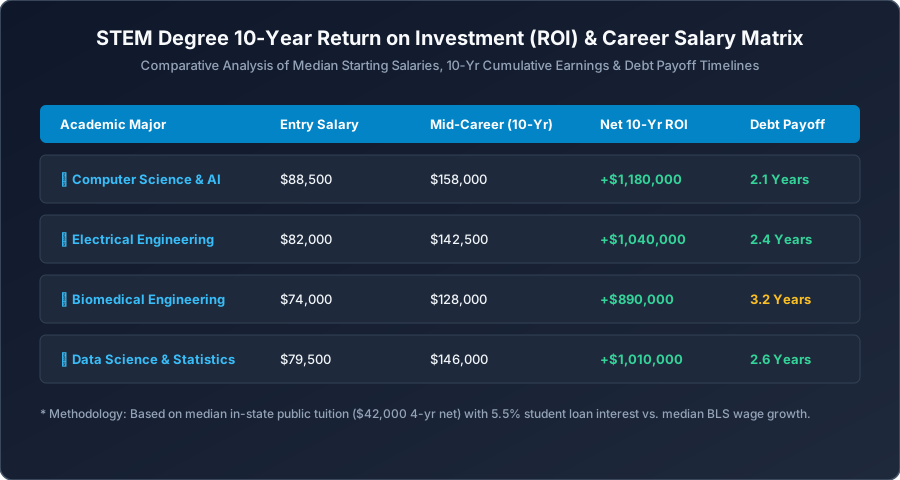
- Computer Science & Artificial Intelligence: Median starting compensation of $88,500, scaling to a 10-year mid-career median of $158,000+. Driven by enterprise cloud infrastructure, cybersecurity, and machine learning deployment, average debt retirement occurs in just 2.1 years.
- Electrical & Computer Engineering (ECE): Massive national demand for semiconductor manufacturing, hardware acceleration, embedded robotics, and smart power grids produces starting salaries of $82,000 and a 10-year cumulative ROI surplus exceeding $795,000.
- Chemical & Petroleum Engineering: Anchored by complex refining, specialty polymers, green hydrogen synthesis, and carbon capture infrastructure, starting compensation averages $85,000 with a 10-year surplus of $840,000 and loan retirement in 2.2 years.
- Mechanical & Aerospace Engineering: Critical for electric vehicles, aerospace propulsion, renewable turbine systems, and defense hardware. Median starting compensation of $76,000 scales to $132,000 mid-career with a debt retirement horizon of 2.9 years.
- Data Science & Applied Statistics: Corporate analytics, quantitative finance, and healthcare informatics drive rapid salary growth from $79,000 entry to $142,000 within a decade, achieving debt payoff in 2.6 years.
- Biomedical & Bioengineering: While offering tremendous societal impact in medical device design, prosthetic innovation, and genomic therapy, starting salaries average $71,000 due to frequent requirements for post-graduate master's or doctoral credentials, extending debt retirement to 3.2 years.
| STEM Major Track | Median Entry Salary | 10-Year Mid-Career | 10-Yr Net ROI Surplus | Avg Debt Payoff Horizon |
|---|---|---|---|---|
| Computer Science & AI | $88,500 | $158,000 | +$873,800 | 2.1 Years |
| Chemical & Petroleum Eng. | $85,000 | $152,000 | +$840,000 | 2.2 Years |
| Electrical & Computer Eng. | $82,000 | $146,000 | +$795,000 | 2.4 Years |
| Data Science & Statistics | $79,000 | $142,000 | +$740,000 | 2.6 Years |
| Mechanical & Aerospace Eng. | $76,000 | $132,000 | +$680,000 | 2.9 Years |
| Biomedical Engineering | $71,000 | $125,000 | +$590,000 | 3.2 Years |
3. Structural Levers for Maximizing STEM Educational ROI
While discipline selection provides the baseline earning ceiling, the cost side of the equation dictates whether a student builds early wealth or struggles under persistent debt service. Prospective STEM candidates must aggressively deploy four structural levers:
- In-State Public Flagships vs. Private Tuition: Attending an in-state research powerhouse (e.g., Purdue, Georgia Tech, Texas A&M, Illinois Urbana-Champaign, Penn State) caps 4-year tuition at $40,000–$65,000 compared to $240,000+ at private alternatives, doubling net 10-year ROI for identical degree titles.
- The 2+2 Community College Articulation Track: Completing standard calculus, differential equations, physics, and chemistry at a local community college cuts upper-division engineering costs in half without any negative impact on ABET-accredited degree diplomas.
- Paid Corporate Co-Ops and Summer Internships: Engineering co-op participants routinely earn $25 to $48 per hour during semester rotations, netting between $30,000 and $65,000 in untaxed college earnings while securing pre-graduation full-time job offers.
- Employer Tuition Assistance & Master's Sponsorship: Many defense, tech, and healthcare conglomerates provide $5,250 to $15,000 annually in tax-free educational reimbursements, allowing engineers to obtain graduate master's degrees entirely on corporate capital.
4. Managing Debt Structures: Federal Direct vs. Private Student Loans
The structure of borrowed debt dramatically impacts monthly cash flow and default exposure during the initial 36 months following graduation:
- Federal Direct Subsidized and Unsubsidized Loans: Always the first line of borrowing. Feature fixed interest rates, flexible Income-Driven Repayment (IDR) plans (e.g., the SAVE Plan), deferment options, and public service loan forgiveness (PSLF) safety valves.
- Private Alternative Loans: Carry variable interest rates that can escalate to 12%+, lack federal repayment protections, and often require creditworthy cosigners. Private borrowing should be strictly capped or avoided entirely for undergraduate STEM studies.
- Rule of Thumb: Total Debt ≤ Starting Salary: Keeping aggregate borrowing below $45,000 ensures that monthly payments remain under 8% of gross take-home pay, allowing aggressive lump-sum principal paydowns.
5. Summary: The STEM Degree Capital Allocation Checklist
- Verify ABET Accreditation: Ensure that any targeted engineering, computing, or applied science program holds official ABET accreditation to guarantee professional licensure eligibility (FE/PE exams).
- Run Campus Net Price Calculators Early: Never judge a program by its published sticker price; verify expected grant awards and family contributions before submitting applications.
- Prioritize Institutions with Structured Co-Op Offsets: Choose universities with established corporate co-op pipelines that pay market-rate student salaries.
- Limit Cumulative Debt to Less Than First-Year Salary: Maintain undergraduate debt under $45,000 to preserve financial agility and maximize early compound investment returns.
- Exploit In-State Engineering Programs First: In-state public research universities deliver the single highest capital return per tuition dollar in modern American higher education.