The Commonwealth of Pennsylvania is home to one of the most intellectually diverse higher education ecosystems in North America. Spanning historic Commonwealth state-related research giants, the affordable 10-campus PASSHE public network with frozen baseline tuition, and world-renowned private research powerhouses, Pennsylvania offers academic tracks for every career trajectory. Navigating this multi-tier system requires understanding institutional charters, articulation frameworks, and regional financial aid packaging.
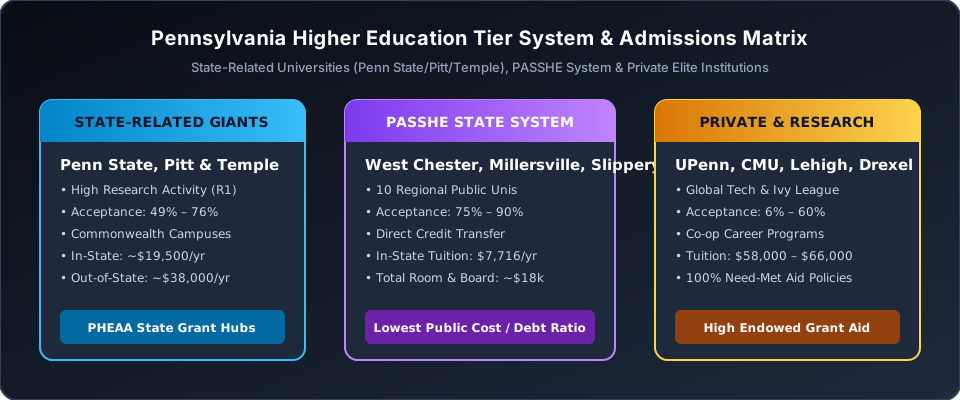
1. Commonwealth State-Related Universities: Massive Flagship Reach
Pennsylvania maintains a unique statutory classification known as "state-related" institutions. These four universities operate as autonomous non-profit entities governed by independent boards of trustees while receiving annual commonwealth appropriations to subsidize tuition rates for Pennsylvania residents:
- Pennsylvania State University (Penn State): The commonwealth's land-grant flagship. Headquartered at University Park with over 45,000 students, Penn State also operates 19 undergraduate Commonwealth Campuses (e.g., Altoona, Behrend, Berks, Harrisburg) that offer the "2+2 Plan"—enabling students to complete two years locally at lower tuition before transitioning seamlessly to University Park. Acceptance rate: ~55%; middle 50% SAT: 1210–1390.
- University of Pittsburgh (Pitt): Located in Pittsburgh's Oakland neighborhood, Pitt is a global powerhouse in biomedical sciences, oncology, neural engineering, and health informatics. Anchored by the University of Pittsburgh Medical Center (UPMC), undergraduate researchers gain unmatched clinical exposure. Acceptance rate: ~49%; middle 50% SAT: 1280–1450.
- Temple University: Situated in North Philadelphia, Temple provides premier programs in media and communications (Klein College), legal studies (Beasley School of Law), business (Fox School of Business), and urban healthcare clinical training. Acceptance rate: ~76%.
- Lincoln University: Located in southern Chester County, Lincoln was founded in 1854 as the nation's first degree-granting Historically Black College and University (HBCU), preparing generations of national leaders in public service, law, and education. Acceptance rate: ~80%.
2. PASSHE System: Debt-Conscious Four-Year Public Degrees
The Pennsylvania State System of Higher Education (PASSHE) includes 10 regionally accredited public universities owned directly by the Commonwealth of Pennsylvania. PASSHE universities prioritize regional workforce needs, teacher preparation, nursing, business management, and applied technology:
PASSHE Affordability Highlights & Campuses:
- In-State Tuition Frozen: Base undergraduate tuition has been held steady at $7,716 per year, providing the lowest public university four-year tuition rate across the entire Commonwealth.
- 10 Regional Anchor Campuses: Includes West Chester University (the system's largest and most competitive campus), Millersville, Slippery Rock, East Stroudsburg, Kutztown, Indiana University of Pennsylvania (IUP), Shippensburg, Cheyney (the nation's first HBCU, founded in 1837), Commonwealth University (Bloomsburg, Lock Haven, Mansfield consolidation), and PennWest (California, Clarion, Edinboro consolidation).
- P2P Transfer Articulation: Pennsylvania Transfer and Articulation Committee (TAOC) framework ensures full block transfer of 60 credits for community college associate degree holders.
3. World-Class Private Research & Specialized Institutions
Pennsylvania boasts an extraordinary concentration of private collegiate institutions, spanning Ivy League research, cutting-edge artificial intelligence, and historic liberal arts colleges:
- University of Pennsylvania (UPenn): Founded by Benjamin Franklin in Philadelphia, UPenn combines classical liberal arts with world-class professional training at the Wharton School of Business, the School of Engineering and Applied Science, and the Perelman School of Medicine. Enforces an all-grant financial aid policy replacing loans for eligible families. Acceptance rate: ~6%.
- Carnegie Mellon University (CMU): Headquartered in Pittsburgh, CMU is globally celebrated for its School of Computer Science, Robotics Institute, Software Engineering Institute, and Tepper School of Business. CMU alumni and faculty have founded hundreds of transformative tech enterprises. Acceptance rate: ~11%.
- Drexel University: Located adjacent to UPenn in University City Philadelphia, Drexel is famous for its mandatory 6-month corporate cooperative education (Co-op) program, connecting students with paid professional assignments across Fortune 500 companies before graduation.
- Lehigh University & Villanova University: Premier private institutions recognized for top-ranked engineering, finance, and accounting programs with exceptionally high post-graduation job placement rates.
- Prestigious Liberal Arts Colleges: Swarthmore College, Haverford College, and Bryn Mawr College (the Tri-College Consortium), along with Dickinson College, Franklin & Marshall, and Lafayette College, provide intimate seminar-style instruction and peerless medical/law school admission rates.
| System Category | Representative Campuses | Annual In-State Tuition | Admissions Selectivity |
|---|---|---|---|
| Commonwealth State-Related | Penn State, Pitt, Temple, Lincoln | $17,500–$20,500 (PA resident base) | Moderate to Selective (49%–76% acceptance; SAT optional at most) |
| PASSHE State Universities | West Chester, Millersville, Slippery Rock, IUP | $7,716 (Frozen statutory tuition) | Accessible to Moderate (70%–88% acceptance; GPA prioritized) |
| Elite Private Research | UPenn, Carnegie Mellon, Lehigh, Villanova | $62,000–$68,000 (Sticker price) | Highly Selective (6%–25% acceptance; rigorous holistic portfolio) |
| Pennsylvania Community Colleges | CCAC, CCP, Bucks, Montgomery, Northampton | $3,600–$4,800 (District resident) | Open Admissions; guaranteed TAOC 60-credit articulation |
4. Navigating Pennsylvania Financial Aid: PHEAA State Grants & Institutional Aid
Financing a collegiate degree in Pennsylvania involves coordinating federal FAFSA aid with state-specific grant programs administered by the Pennsylvania Higher Education Assistance Agency (PHEAA):
- PHEAA State Grant Program: Provides need-based grant funding of up to $5,750 per year to eligible full-time undergraduate students residing in Pennsylvania. Awards do not require repayment. The strict annual deadline is May 1 for all four-year college applicants.
- Ready to Succeed Scholarship (RTSS): Administered by PHEAA in partnership with the PA Department of Education, RTSS provides merit- and need-based awards up to $2,500 for students who have completed at least one year of postsecondary education with a cumulative GPA of 3.25 or higher.
- Institutional Need-Based Grants: Private institutions such as UPenn and Carnegie Mellon utilize the CSS Profile to award generous institutional grants that bridge the gap between parental Expected Family Contribution (EFC/SAI) and total cost of attendance.
5. Pennsylvania Domicile & In-State Tuition Determination Rules
Because nonresident tuition at state-related universities exceeds in-state tuition by more than $18,000 annually, establishing Pennsylvania residency is critical. Under Pennsylvania Code Title 22, Chapter 35, the following legal criteria govern in-state classification:
- Continuous Physical Presence: The student or their legal guardian must have maintained continuous physical domicile within the Commonwealth for at least 12 consecutive months immediately prior to the first day of classes.
- Intent to Establish Permanent Domicile: Relocating to Pennsylvania solely for educational purposes does not constitute bona fide residency. Applicants must prove legal ties including Pennsylvania driver's licensing, vehicle registration, state income tax filings, and continuous residential lease agreements.
- Financial Emancipation Standards: Undergraduates claiming independent resident status without parental Pennsylvania domicile must provide federal and state tax returns showing two full tax years of self-sufficiency without parental claim as a tax dependent.
6. Strategic Admissions Runbook for Pennsylvania Applicants
- Target Early Action and Rolling Deadlines: Penn State and Pitt operate rolling admissions that open in early August. Submitting by October 15 drastically increases the probability of receiving preferred campus and major placement.
- Submit FAFSA & Complete the PHEAA Form by May 1: Ensure the federal FAFSA is completed and follow through to the PHEAA State Grant portal to confirm parental tax validation before the strict statutory May 1 cut-off.
- Evaluate the Penn State 2+2 Plan for Substantial Cost Reduction: Enrolling at a Commonwealth Campus (e.g., Altoona or Harrisburg) for lower-division coursework reduces annual tuition by over $4,000 per year compared to University Park.
- Leverage PASSHE for Unmatched Debt-Conscious Degrees: With tuition locked at $7,716 per year, students seeking high-demand degrees in nursing, education, and cybersecurity can graduate with minimal debt burden.
- Explore Drexel Co-op for Immediate Career Earnings: Take advantage of three 6-month co-op cycles where students earn an average of $20,000+ per co-op cycle while building corporate resumes prior to graduation.